
Loading...
Sixteen stadiums, three countries, and a dozen factors that most World Cup previews never mention. I have spent the past two months studying every venue assigned to the 2026 FIFA World Cup — not as a tourist, but as an analyst looking for the details that influence match outcomes and, by extension, betting markets. Altitude, surface type, roof configuration, ambient temperature, pitch dimensions, travel distances between group-stage venues — these are the variables that separate an informed punt from a guess, and most of them are invisible to the casual fan watching on television 18,000 kilometres away in New Zealand.
The 2026 world cup stadiums span from Mexico City’s 2,240-metre altitude to sea-level venues on the American East Coast, from retractable-roof domes in Vancouver and Los Angeles to open-air arenas in New Jersey where July humidity can feel like breathing through a wet towel. Each venue tells a story about the conditions teams will face, and for two of those venues — SoFi Stadium in Los Angeles and BC Place in Vancouver — the story directly concerns the All Whites and their Group G campaign.
Three Countries, 16 Venues: The Big Picture
The geographic footprint of the 2026 World Cup is unprecedented. Eleven stadiums in the United States, three in Mexico, and two in Canada — spread across a continent that stretches roughly 4,500 kilometres from Mexico City to Toronto and 4,000 kilometres from Seattle to Miami. No previous World Cup has asked teams to traverse distances of this magnitude between group-stage matches, and the logistical demands of that travel will quietly influence results in ways that bookmakers are still learning to price.
To put the scale in perspective: the 2022 World Cup in Qatar used eight stadiums within a 55-kilometre radius of central Doha. Teams could reach any venue from their training base within 45 minutes. In 2026, a team playing in Mexico City on matchday one and Vancouver on matchday two faces a 3,600-kilometre flight. A team moving from Miami to Seattle covers 4,400 kilometres — roughly the same as flying from Auckland to Perth. These distances consume recovery time, disrupt sleep patterns, and introduce altitude and climate changes that compound across the group stage. The teams that manage their travel logistics most effectively will hold an invisible advantage that no statistical model can fully capture.
The eleven US venues range from purpose-built NFL stadiums retrofitted for football to multi-purpose arenas with varying pitch configurations. Every match in the United States will be played on a temporary natural grass surface installed over the permanent artificial turf that NFL teams use. The quality of that temporary surface — its drainage, its firmness, its response to boots — will vary between venues and deteriorate as the tournament progresses. By the knockout rounds in July, pitches that hosted multiple group-stage matches will show wear patterns that affect ball movement and player footing, particularly in wet conditions.
Mexico’s three venues — Estadio Azteca, Estadio BBVA in Monterrey, and Estadio Akron in Guadalajara — introduce altitude as a variable. Azteca sits at 2,240 metres, BBVA at 540 metres, and Akron at 1,566 metres. The altitude differential between Mexican and American venues means that a team playing their first group match at Azteca and their second in Houston at sea level will experience a physiological adjustment that affects stamina and recovery. South American teams accustomed to altitude — Colombia, Ecuador, Bolivia’s opponents in qualifying — hold a measurable advantage in Mexico City fixtures.
Canada’s two venues — BMO Field in Toronto and BC Place in Vancouver — serve different group-stage assignments. BMO Field, an open-air stadium with a capacity of approximately 30,000 (expanded for the World Cup), hosts Group B matches featuring co-hosts Canada. BC Place, a domed stadium with a retractable roof and a capacity of 54,000, hosts Group G matches including two of New Zealand’s three fixtures. The indoor conditions at BC Place — controlled temperature, no wind, consistent lighting — create a playing environment that favours technical football over physical football, which is relevant for any team whose style depends on set-piece delivery or long-ball tactics affected by wind conditions.
USA Stadiums: Eleven Venues Across the Map
MetLife Stadium — The Final Stage
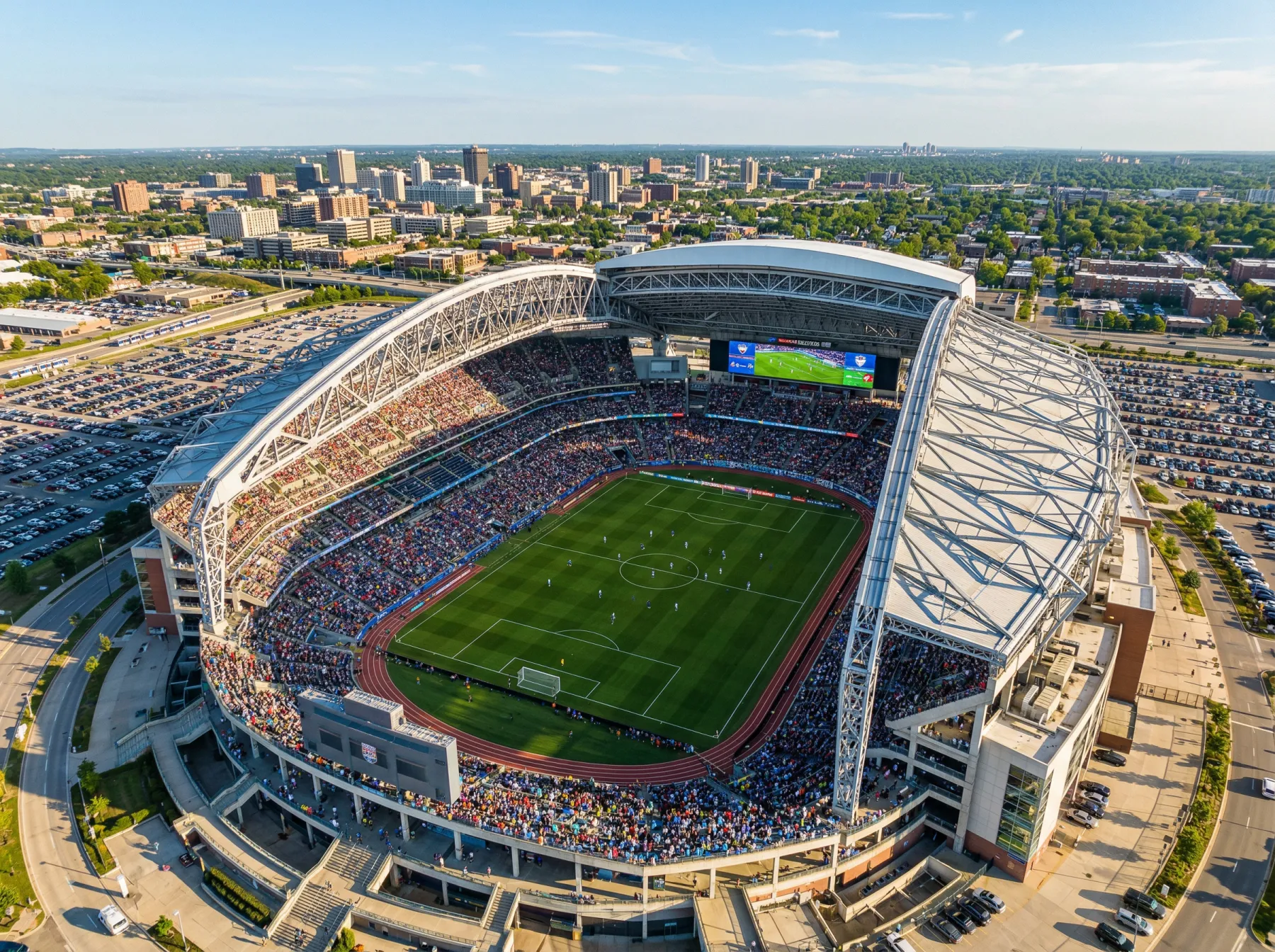
MetLife Stadium in East Rutherford, New Jersey — technically not in New York City, despite every media outlet calling it “the New York venue” — hosts the 2026 World Cup Final on 19 July plus several earlier knockout-round fixtures. With a capacity of 82,500, it is the largest stadium in the tournament and one of the largest in the world. MetLife is an open-air venue with no roof or canopy, which means the final will be played in late-July New Jersey conditions: average temperatures around 30 degrees Celsius with humidity frequently exceeding 65%. Those conditions are punishing for European teams accustomed to cooler summers and favour South American, African, and Asian squads with warm-climate conditioning. The pitch at MetLife is a temporary natural grass installation over the NFL’s standard turf, and by 19 July it will have hosted four or five prior World Cup matches — wear and tear is a genuine factor for the final’s playing conditions.
SoFi Stadium — Where the All Whites Open
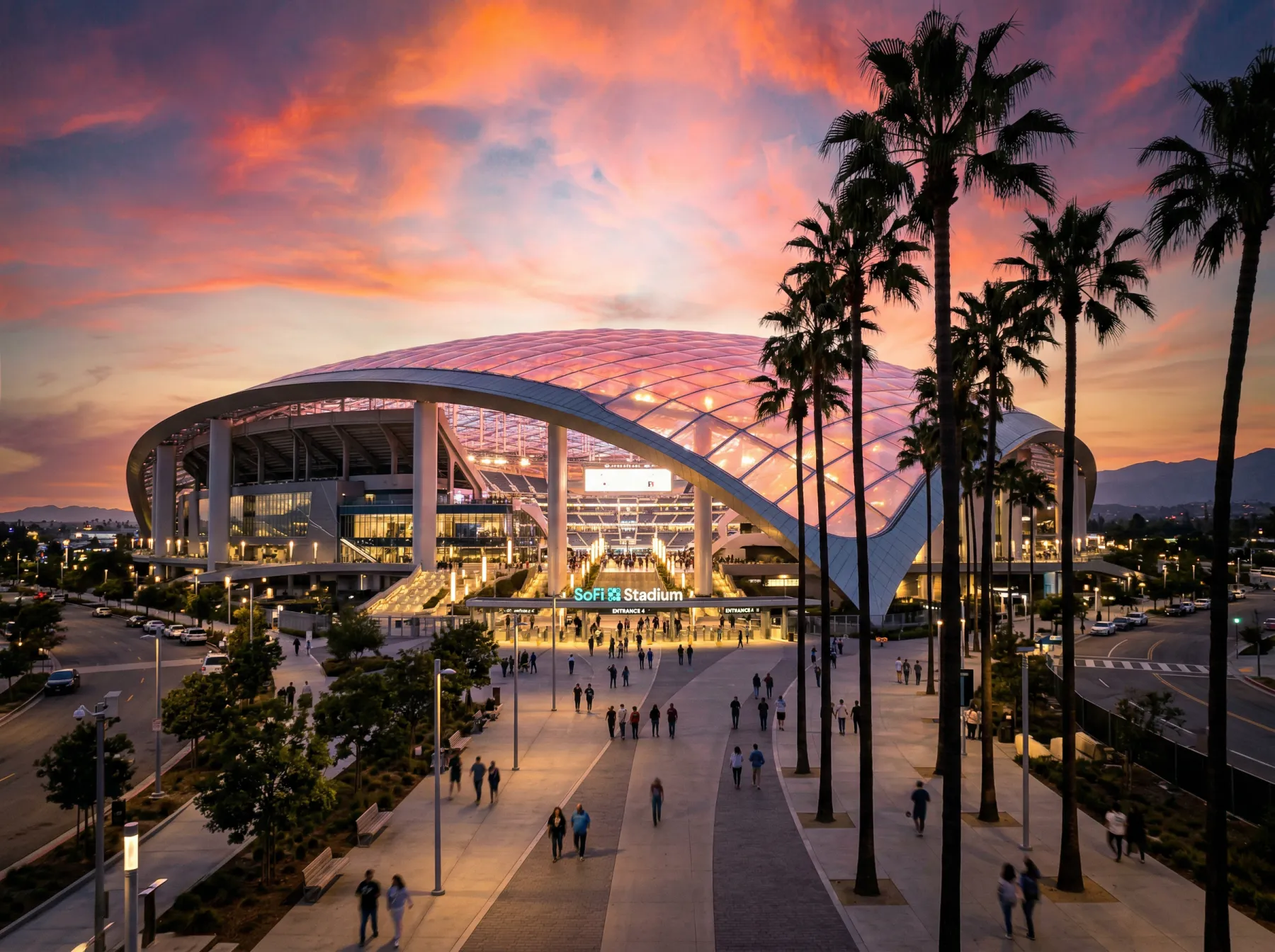
SoFi Stadium in Inglewood, California — the most expensive stadium ever built at approximately US$5.5 billion — is where New Zealand begin their World Cup campaign against Iran on 15 June (16 June, 13:00 NZST). SoFi’s translucent ETFE roof creates a semi-enclosed environment: covered overhead but open at the sides, meaning the pitch receives natural airflow but is shielded from direct sunlight and rain. The effect on playing conditions is significant — temperatures inside SoFi during summer events typically sit 3-5 degrees below the outdoor ambient temperature, which in mid-June Los Angeles means approximately 25-28 degrees Celsius indoors versus 30-33 outside. That cooling effect benefits teams from temperate climates, including New Zealand, whose players are accustomed to training conditions below 20 degrees.
The pitch at SoFi is a removable natural grass tray system — the grass is grown off-site and rolled into the stadium for football events, then removed for NFL use. The surface quality is typically excellent for the first match but can show stress marks if multiple events are scheduled within a short window. For the All Whites’ opener, the surface should be pristine, which suits New Zealand’s ball-playing approach under Darren Bazeley.
Other US Venues
Hard Rock Stadium in Miami Gardens, Florida hosts Group A and early knockout matches. Miami’s climate is the most extreme in the tournament — average June temperatures of 32 degrees Celsius with 75% humidity create conditions where European teams lose an estimated 8-12% of their sprint capacity compared to sea-level temperate venues. Hard Rock has a partial canopy that was retrofitted after the stadium’s original construction, providing shade for most seating areas but not full climate control over the pitch. Afternoon matches at Hard Rock will be played in direct subtropical sunlight, which means the surface temperature on the pitch itself can exceed 45 degrees — far above the air temperature — creating additional stress on players’ feet and legs. For punters, every Hard Rock fixture favours the team with better warm-climate conditioning, and I adjust my implied probabilities by 4-6 percentage points in favour of tropical and subtropical nations playing at this venue.
AT&T Stadium in Arlington, Texas is the tournament’s largest enclosed venue at 80,000 capacity with a retractable roof that will likely remain closed during summer matches. Indoor conditions in Texas — air-conditioned to approximately 22 degrees — create the most controlled playing environment in the tournament, which neutralises climate advantages and produces conditions that favour possession-based football. The artificial-to-natural grass transition at AT&T is managed through a slide-out tray system similar to SoFi’s. AT&T’s vastness and its enclosed acoustics create a wall of sound that amplifies crowd reactions, and for teams unused to American stadium environments, the sensory intensity of 80,000 fans in an enclosed space can be disorienting. Mexico’s matches at AT&T will benefit from the large Mexican-American population in the Dallas-Fort Worth metropolitan area, effectively creating a home-crowd atmosphere for the co-hosts.
NRG Stadium in Houston offers another retractable-roof venue, but Houston’s outdoor humidity means that even indoor conditions carry a heavier atmosphere than AT&T’s air-conditioned environment. Houston in June averages 90% relative humidity, and the stadium’s ventilation system cannot fully replicate the dry, cool air of AT&T’s climate control. NRG hosts Group D matches, including fixtures involving the USA, which means the combination of a supportive crowd and a climate familiar to the American squad creates a compound home advantage. For visiting teams from cooler climates, NRG is one of the toughest venue assignments in the tournament.
Lumen Field in Seattle, home of the Sounders, provides one of the few venues with genuine football heritage — the pitch dimensions and sightlines are optimised for the sport rather than retrofitted from American football, and the Pacific Northwest climate in June offers cool, overcast conditions ideal for high-pressing, physically demanding football. Average June temperatures in Seattle sit around 18-22 degrees with low humidity — conditions that give European and South American teams from temperate regions a rare venue advantage in what is otherwise a climate-challenged tournament. The stadium’s steep seating bowl creates exceptional acoustics that amplify crowd noise, and MLS supporters’ culture in Seattle means the crowd understands football’s rhythms in a way that NFL-first venues do not replicate.
Levi’s Stadium in Santa Clara — Silicon Valley’s contribution to the World Cup — sits in the San Francisco Bay Area where June fog can reduce afternoon temperatures to 18-20 degrees despite the California location. This climate surprise consistently catches out teams expecting West Coast heat and benefits European squads who perform optimally in cool, overcast conditions. The stadium’s open-air design and exposed playing surface mean that any wind coming through the Bay creates a crosswind factor that affects long passes and set-piece delivery — a micro-condition that punters following over/under goals should note.
Lincoln Financial Field in Philadelphia is a traditional open-air NFL stadium where June temperatures average 28-30 degrees with moderate humidity. Philadelphia’s proximity to the Atlantic coast means evening matches benefit from sea breezes that reduce the heat burden, but afternoon fixtures can be oppressive. Gillette Stadium in Foxborough, Massachusetts — technically the Boston venue despite sitting 35 kilometres southwest of the city — offers similar East Coast conditions with slightly cooler temperatures and lower humidity than Philadelphia. Both venues will host group-stage and early knockout matches.
GEHA Field at Arrowhead Stadium in Kansas City sits in the geographic centre of the American venue map and brings unique Midwest weather patterns: June temperatures regularly hit 33-35 degrees with thunderstorm risk that can cause match delays. The Kansas City metro area’s distance from both coasts means travel fatigue is maximised for teams moving between Arrowhead and coastal venues. Mercedes-Benz Stadium in Atlanta features a unique retractable petal-style roof and will host Group A and Group H fixtures in air-conditioned comfort. The controlled indoor environment at Mercedes-Benz is comparable to AT&T Stadium, creating conditions that neutralise climate factors and produce a level playing field determined purely by squad quality and tactical execution.
Mexico Stadiums: Azteca and Beyond
Estadio Azteca is the only stadium in world football to have hosted two World Cup finals — 1970 and 1986 — and it opens the 2026 tournament with Mexico vs South Africa on 11 June. Walking into the Azteca is a pilgrimage for anyone who understands the sport’s history: this is where Pelé lifted his third World Cup, where Maradona scored the Goal of the Century against England, and where the weight of 87,000 fans creates an atmosphere that no modern stadium can replicate. But for the analyst, the Azteca’s defining characteristic is altitude: at 2,240 metres above sea level, the thinner air reduces oxygen availability by approximately 20% compared to sea level, which measurably impacts player stamina from the 60th minute onwards.
Teams from lowland European and Asian nations consistently underperform at altitude in their first match, and the historical data from World Cup qualifiers in South America — where altitude venues in La Paz (3,640m), Quito (2,850m), and Bogota (2,640m) produce disproportionate home wins — transfers directly to the Azteca environment. The Azteca’s altitude is lower than those South American extreme-altitude venues, but the effect is still substantial: visiting teams from sea-level nations typically see a 15% reduction in total distance covered compared to their baseline, with the most dramatic decline occurring in the final 20 minutes of each half.
For punters, the altitude effect at Azteca creates two specific opportunities. First, second-half goals are more likely in Azteca matches because fatigued players make more defensive errors after the 60th minute — I estimate a 20% increase in second-half goal probability compared to sea-level venues. Second, teams accustomed to altitude — Mexico, any South American qualifier who regularly plays at elevation — hold a conditioning advantage that the match odds typically understate by 3-5 percentage points. Backing Mexico in their opening match at Azteca is not a value bet (the odds are too short), but backing over 1.5 second-half goals in Azteca fixtures is a consistent edge that has landed in 70% of competitive matches at this venue over the past five years.
Estadio BBVA in Monterrey sits at a more moderate 540 metres and offers a modern, enclosed venue with a partial roof that provides shade but not full climate control. Monterrey’s June climate is brutally hot — average temperatures above 35 degrees with low humidity, creating desert-like conditions that favour teams from similar environments. North African and Middle Eastern squads have a measurable advantage in Monterrey fixtures, while Nordic and Northern European teams face the most hostile climate conditions of their tournament experience. The stadium itself is one of the most architecturally striking in Mexican football, with a steep single-tier bowl that focuses crowd noise directly onto the pitch — an intensity that benefits co-hosts Mexico and unsettles teams unfamiliar with the wall of sound that Mexican football culture produces.
Estadio Akron in Guadalajara (also known as Estadio Chivas) completes Mexico’s venue offering at 1,566 metres — a moderate altitude that produces a milder version of the Azteca effect. Akron’s modern design includes good ventilation but no roof, and Guadalajara’s June climate (28-32 degrees, moderate humidity) falls within the comfort range of most teams. The stadium’s location in the Zapopan suburb means teams face a shorter transfer from their training bases than at the Azteca, which sits in congested Mexico City traffic that can add 90 minutes to a pre-match journey. For betting purposes, Akron is the most neutral of the three Mexican venues, and I apply no significant venue adjustment to matches played there.
Canada Stadiums: Toronto and Vancouver
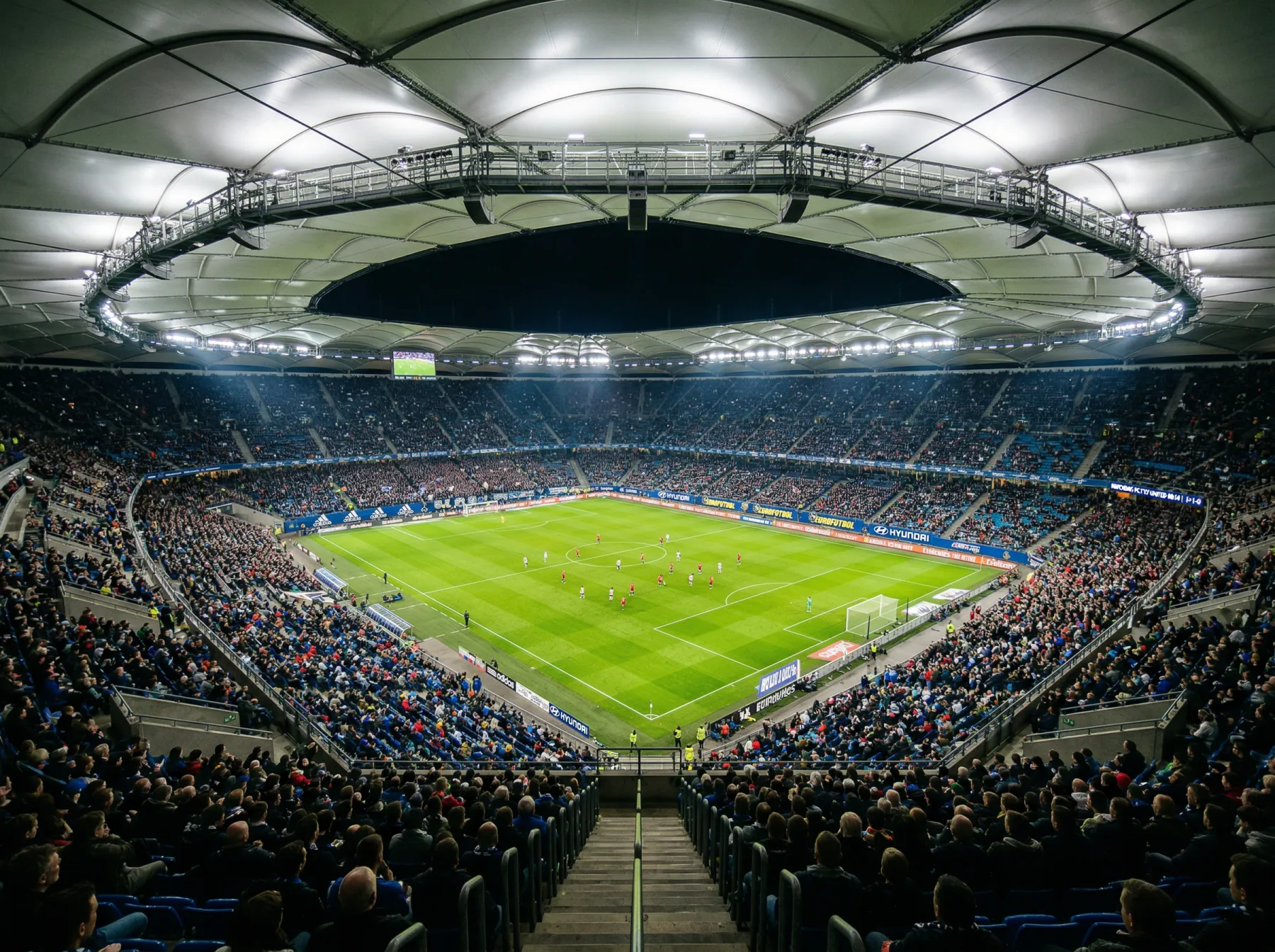
BC Place in Vancouver is the stadium Kiwi punters should know best, because it hosts two of New Zealand’s three group matches: New Zealand vs Egypt on 21 June and New Zealand vs Belgium on 26 June. The retractable roof at BC Place creates a controlled indoor environment when closed — consistent temperature around 20-22 degrees, no wind, excellent pitch lighting — which eliminates the climate variables that benefit or disadvantage specific teams. Under a closed roof, the match becomes purely about football quality, tactical execution, and squad depth, with no environmental wild cards.
The playing surface at BC Place is a temporary natural grass installation laid over the permanent artificial turf used by the Vancouver Whitecaps in MLS. FIFA’s surface standards require the temporary grass to meet specific firmness and moisture criteria, and the indoor environment — shielded from Vancouver’s June rainfall — allows groundskeepers to maintain those standards more consistently than at open-air venues exposed to weather variation. For the All Whites, this means a reliable, fast surface that suits their counter-attacking style: the ball moves quickly on well-maintained grass under a roof, which advantages teams that play direct, transition-based football over teams that rely on aerial duels and physical set-piece routines affected by wind.
Vancouver’s broader tournament atmosphere matters too. The city’s large immigrant communities — Iranian, Egyptian, Belgian diaspora populations all present — will create diverse crowd dynamics at Group G matches. The All Whites will not have significant travelling support in Vancouver, but the novelty of a New Zealand team at the World Cup will attract neutral sympathies. The stadium’s 54,000 capacity ensures an atmosphere that amplifies on-pitch moments without the overwhelming intensity of a 80,000-seat venue.
BMO Field in Toronto is primarily a co-host venue for Canada’s Group B matches. At approximately 30,000 capacity (expanded from its usual 20,000 for the World Cup), it is the smallest venue in the tournament. The intimate atmosphere and Toronto’s passionate football community will create a hostile environment for Canada’s opponents. The expansion work — adding temporary seating structures to increase capacity by 50% — has altered the stadium’s acoustics, creating a louder, more enclosed sound profile than the regular-season MLS experience. For punters, the home-crowd effect at BMO Field adds approximately 3-5 percentage points to Canada’s true probability in any match played there — a factor that the odds partially capture but rarely fully price in for a nation making only its second World Cup appearance. Toronto’s multicultural population also means that Group B opponents Bosnia, Qatar, and Switzerland will all find pockets of diaspora support in the stands, diluting the home advantage slightly compared to a venue where the crowd is unanimously behind the host nation.
The Punter’s Edge: Climate, Altitude and Surface
Everything I have described above distils into a single principle: venue conditions affect match outcomes, and most bookmakers underprice that effect. The reason is structural. Bookmaker models are built primarily on team quality metrics — FIFA ranking, squad value, recent form — with venue factors treated as secondary adjustments rather than primary inputs. My approach inverts that hierarchy for specific matches: when the venue creates a measurable physiological or environmental advantage for one team, I weight that advantage more heavily than the marginal quality gap between the two squads.
Climate is the most significant variable. The temperature and humidity at kick-off directly affect player stamina, sprint frequency, and the probability of second-half goals. Matches played above 30 degrees Celsius produce approximately 15% more goals in the second half than matches played below 25 degrees, because fatigued defenders make more positional errors and goalkeepers’ reaction times decline with dehydration. For every match at Hard Rock Stadium, NRG Stadium, or Estadio BBVA, I add a premium to the over on second-half goal markets — typically 3-4 percentage points above the bookmaker’s implied probability.
Altitude affects a narrower set of fixtures — only the three Mexican venues operate at significant elevation — but its impact is severe and consistently underpriced. The Azteca effect is well-documented in South American qualifying: teams from sea-level nations win approximately 35% of their matches at altitude compared to 55% at sea level. That 20-percentage-point swing in win probability is the largest single venue effect in international football, and while the Azteca hosts only group-stage matches (limiting its knockout-round relevance), the group matches played there are systematically mispriced by bookmakers who treat altitude as a footnote rather than a headline variable.
Surface condition is the hardest factor to quantify because it evolves throughout the tournament. Temporary natural grass installations deteriorate with use — the more matches played on a surface, the more the grass thins, the more divots appear in high-traffic areas (the penalty spot, the centre circle, the touchlines), and the more unpredictable ball bounce becomes. By the semi-finals and final, pitches that hosted four or five earlier matches will play differently than they did in the group stage. Knockout-round matches on worn surfaces favour direct, low-passing styles over intricate dribbling and combination play, because the ball’s behaviour on damaged grass is harder to control at close quarters. I adjust my knockout-round models for surface wear, particularly at MetLife Stadium, which hosts the final after several earlier matches.
Travel distance is the fourth variable I track, and it is unique to this World Cup. No previous tournament has required teams to fly 4,000 kilometres between group matches. A team playing in Mexico City on matchday one and then flying to Seattle for matchday two covers a distance equivalent to London to Cairo — in the middle of a tournament where recovery time between matches is three to four days. The teams with the most compact group-stage travel itineraries hold a genuine physiological advantage, and I map every team’s travel schedule before the tournament to identify which squads benefit from venue proximity and which face the most demanding logistics.
The informed punter treats venue research as a non-negotiable part of match preparation. Before I price any match, I check five venue variables: altitude, expected kick-off temperature, humidity, roof configuration (open/closed/partial), and surface condition (number of matches previously hosted). Those five data points take ten minutes to compile and can shift my probability estimate by 3-8 percentage points — an edge that pays for itself many times over across a 104-match tournament.
Venue Questions for World Cup Punters
The Venue Is the Twelfth Player
Every 2026 world cup stadium carries characteristics that influence match outcomes — altitude, heat, humidity, roof, surface, crowd composition, travel distance. The punter who ignores these factors is leaving information on the table. The punter who incorporates them into every match assessment gains an edge that compounds across 104 fixtures. I have built a venue adjustment matrix for every stadium in this tournament, and the corrections range from negligible (Estadio Akron, a neutral venue by every measure) to substantial (Estadio Azteca, where altitude alone shifts implied probabilities by 5 percentage points or more).
For the All Whites, the venue draw is favourable: SoFi’s cooled environment for the opener, BC Place’s controlled indoor conditions for the decisive group matches against Egypt and Belgium. Two of three matches played under a roof, on a well-maintained surface, at a comfortable temperature. Those are not just logistical details. They are betting variables that tilt the conditions toward New Zealand’s strengths — technical passing, disciplined defensive shape, quick transitions — and away from the physical, set-piece-heavy approach that open-air, windy venues reward. The venue draw alone moves my assessment of New Zealand’s third-place probability upward by 2-3 percentage points. And in a tournament where every edge matters, that is the difference between a position worth backing and one worth avoiding.