

Loading...
I placed my first World Cup punt in 2010 — a modest wager on Slovakia to beat Italy in the group stage. The odds sat at 5.50, the logic was sound, and Slovakia won 3-2. That single result taught me more about tournament betting than any guide ever could: World Cups reward the punter who does the homework the casual fan skips.
The 2026 FIFA World Cup rewrites the rulebook for anyone who treats this tournament as a betting event. Forty-eight teams instead of thirty-two. One hundred and four matches spread across thirty-nine days. Three host nations spanning four time zones. The format expansion alone creates market inefficiencies that bookmakers are still calibrating, and that gap between their models and reality is precisely where value lives. This is the world cup 2026 betting guide I wish someone had handed me before my first tournament — built from nine years of covering these markets, losing plenty along the way, and learning what actually moves the needle when the whistle blows.
The 48-Team Format: A Punter’s Breakdown
When FIFA announced the expansion from 32 to 48 teams, a colleague of mine in Auckland called it “the biggest gift to informed punters since decimal odds replaced fractions.” He was half-joking, but the logic holds. More teams means more matches with lopsided quality gaps, and lopsided quality gaps produce predictable outcomes — exactly the conditions where disciplined betting thrives.
Here is how the new structure works. Twelve groups of four replace the old eight groups of four. Each team plays three group matches, identical to the previous format, so the rhythm of the group stage feels familiar. The critical change sits in the advancement rules: the top two teams from each group qualify for the Round of 32, and the eight best third-placed teams also advance. That means 32 out of 48 teams — two-thirds of the entire field — progress beyond the group stage.
For punters, this third-place mechanic is the single most important structural shift since the back-pass rule changed how defensive football operates. In the old 32-team format, finishing third in your group sent you home. Now, finishing third keeps your tournament alive as long as your goal difference and points tally stack up against the other eleven third-placed sides. The ripple effect on betting markets is enormous. Teams trailing after two matches no longer treat the final group game as a dead rubber — they fight for every goal because goal difference becomes a tiebreaker with real knockout-round consequences.
Consider what this means for over/under goals markets. In previous World Cups, the final round of group matches often produced conservative scorelines when both teams had already secured qualification or elimination. In 2026, at least four or five groups will feature a third match where goal difference matters desperately for the third-placed team, which drives attacking football and higher-scoring matches. The historical average of 2.65 goals per game in World Cup group stages could climb above 2.80 under the new format, and bookmakers setting their lines based on historical data rather than structural logic will misprice these matches.
The knockout bracket itself extends to a Round of 32 before the Round of 16, adding an extra elimination round. That extra round favours deeper squads — teams with 26-player rosters capable of rotating without significant quality drops. For outright winner markets, this is a filter: nations with thin squads and heavy reliance on a single star player face an additional round of potential upset before they reach the quarter-finals. I factor squad depth into every outright assessment now, weighting it more heavily than I did for any previous tournament.
One structural detail punters overlook: the scheduling asymmetry. Matches take place across three countries and four time zones. A team playing in Vancouver at 14:00 local time on a Tuesday and then flying to Houston for a Saturday evening kick-off faces different fatigue and climate adjustment pressures than a team staying within the same city for all three group matches. Travel logistics will quietly influence results, particularly for squads from outside the Americas who arrive with minimal acclimatisation time. I track every team’s travel itinerary before pricing their match odds — it is a small edge, but small edges compound across 104 matches.
The 48-team format also dilutes the overall quality of the field. Four debutant nations — Cabo Verde, Curacao, Jordan, and Uzbekistan — enter the tournament without any World Cup pedigree. Historical data shows that debutant nations concede an average of 1.3 more goals per game than the tournament median in their first appearance. For punters targeting team totals or Asian handicap lines, matches involving debutants offer some of the most reliable edges in the group stage.
Key Betting Markets for 2026
A punter who only bets on match results is like a carpenter who only owns a hammer. The 2026 World Cup offers dozens of market types, and the smartest bets often hide in the markets that casual punters ignore entirely. I break the landscape into three tiers: outright futures, group-stage markets, and player-level propositions.
Outright Winner
The outright winner market — picking the team that lifts the trophy on 19 July at MetLife Stadium — is the most liquid and the most discussed. It is also, paradoxically, one of the hardest markets to find genuine value in, because bookmakers dedicate their sharpest analysts to pricing it. The defending champions Argentina sit near the top of most boards alongside France, England, and Brazil, with decimal odds typically ranging between 4.50 and 8.00 for the favourites. Germany, Spain, and Portugal occupy a second tier between 8.00 and 15.00. Beyond that, the field opens up dramatically.
My approach to outright markets is contrarian by design. I look for teams priced between 15.00 and 40.00 whose underlying metrics — expected goals data, squad age profile, recent tournament form — suggest they have a genuine path to the semi-finals. A team that reaches the semi-finals at 25.00 pays handsomely even with an each-way structure, and the expanded bracket makes deeper runs more accessible for well-organised sides outside the traditional elite.
One principle I apply without exception: never back the outright winner at single-digit odds unless you have a structural reason the market is wrong. At 5.00, you need the team to win one in five tournaments to break even — and no team in World Cup history has been that consistent. France reached two of the last three finals and still would not cover 5.00 over a five-tournament sample.
Group Stage Markets
Group-stage betting is where I allocate the majority of my World Cup bankroll. Match results, correct scores, both teams to score, over/under goals, Asian handicaps, and group winner markets — the variety is vast, and the pricing is softer because bookmakers spread their attention across 48 simultaneous group campaigns.
Group winner markets deserve special attention. In a four-team group, the favourite typically sits between 1.60 and 2.20 to top the group. But the third-place qualification rule changes the dynamics: if the favourite secures advancement early, their third match becomes a squad-rotation exercise, which means second-placed teams can overtake on the final day. I have seen group winner markets shift by 30% or more after the second round of matches in previous tournaments, and the 2026 format amplifies that volatility.
Both teams to score (BTTS) is another group-stage gold mine. In the 2022 World Cup, BTTS landed in 56% of group matches. The expanded field in 2026 introduces more mismatches, but also more desperate third-placed teams chasing goals — a combination that historically pushes BTTS rates above 50%. I target BTTS in matches where the underdog has a prolific forward capable of scoring against the run of play.
Player Markets
Player propositions — top scorer, first goalscorer, anytime goalscorer, player of the tournament, cards received — represent the frontier of World Cup betting. These markets are notoriously volatile because individual player performance depends on team advancement, minutes played, tactical role, and pure variance. A striker whose team exits in the group stage simply cannot compete for the Golden Boot regardless of talent.
The key insight for player markets is exposure: back players from teams with a realistic path to at least the quarter-finals, because they will play a minimum of five matches. A forward playing five matches at 2.50 to score anytime in each game offers far more value than a star at 1.80 whose team might be eliminated after three. I run a simple expected-goals-per-90-minutes filter combined with team advancement probability to rank my player market selections. Penalty takers also deserve a separate look — in the 2022 World Cup, 23 penalties were awarded across 64 matches, and the designated penalty taker’s anytime goalscorer odds rarely account for this additional goal source. In a 104-match tournament, the penalty volume will climb, and punters who identify which forwards also take penalties gain a measurable edge in anytime scorer markets.
Reading Decimal Odds: The NZ Standard
Every Kiwi punter who has walked into a TAB or opened the app knows decimal odds instinctively — they are the native language of betting in Australasia. But knowing how to read them and knowing how to extract information from them are two very different skills, and the gap between those skills separates recreational punters from profitable ones.
Decimal odds represent the total return on a one-unit stake, including the stake itself. Odds of 3.00 mean a NZ$10 bet returns NZ$30 if it wins — NZ$20 profit plus the original NZ$10 stake. The formula is simple: stake multiplied by odds equals total payout. Where it gets interesting is the reverse calculation: converting odds into implied probability.
Implied probability tells you what the bookmaker believes is the true chance of an outcome. The formula is straightforward — divide 1 by the decimal odds, then multiply by 100 to get a percentage. Odds of 2.00 imply a 50% chance. Odds of 4.00 imply 25%. Odds of 1.50 imply 66.7%. This conversion is the single most useful skill a punter can develop, because it allows direct comparison between your own probability estimate and the bookmaker’s implied probability. When your estimate exceeds the implied probability, you have identified value.
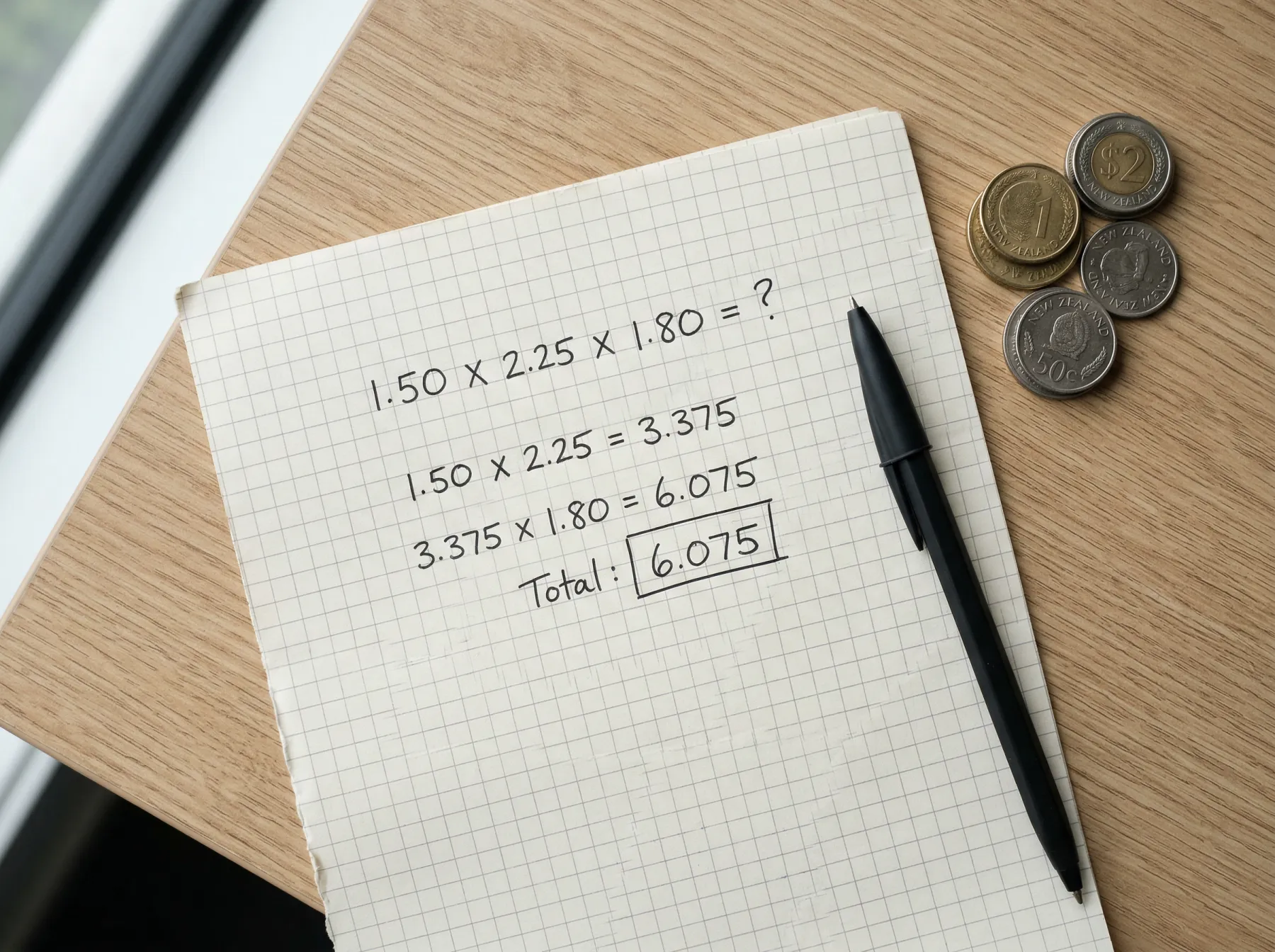
Here is a practical example using a 2026 World Cup Group G match. Suppose the odds for New Zealand to beat Egypt are set at 4.20. The implied probability is 1 divided by 4.20, which equals 0.238, or roughly 23.8%. If your analysis of squad form, tactical matchup, and venue conditions leads you to believe New Zealand has a 30% chance of winning, the gap between 30% and 23.8% represents value. A NZ$20 bet at 4.20 returns NZ$84 on a win — and over many such bets where you consistently identify a probability edge, the mathematics favour you regardless of individual outcomes.
The bookmaker’s margin — sometimes called the overround or vig — is the hidden cost embedded in every set of odds. In a two-outcome market with true 50/50 probability, fair odds would be 2.00 on each side. Instead, the bookmaker might offer 1.90 on each side, creating a combined implied probability of 105.3%. That extra 5.3% is the margin. For World Cup match markets, typical margins run between 4% and 8% depending on the operator and the match profile. High-profile matches like a semi-final carry tighter margins because sharper punters and higher liquidity force the bookmaker to be more competitive. Group matches involving lesser-known teams often carry wider margins — and wider margins mean worse value for punters unless you can identify mispriced outcomes within them.
I check the overround on every market I consider. If the total implied probability exceeds 108%, I move on — the margin is too fat to overcome consistently. Between 103% and 106% is the sweet spot for group-stage match markets, and that is where most of my World Cup betting activity concentrates.
Spotting Value in World Cup Markets
In 2018, I spent three hours building a spreadsheet model for the Russia World Cup group stage. It flagged South Korea to beat Germany in the final group match at 11.00. I did not back it — the odds felt too generous to be real, and my instinct overruled my model. South Korea won 2-0 and I learned a lesson worth far more than the payout I missed: value betting requires trusting your process over your gut.
Value exists when the true probability of an outcome exceeds the probability implied by the odds. It does not mean the outcome is likely — it means the price is wrong relative to the actual chance. A bet at 6.00 on a team with a genuine 20% chance of winning is a value bet, even though that team will lose four out of five times. The profit comes from the one time in five when you collect at a price that overpays for the risk.
Finding value in World Cup markets requires a systematic approach. I use a three-filter method. First, I build an independent probability estimate for each outcome using recent form data, head-to-head records, squad quality metrics, and situational factors like travel distance and climate. Second, I convert the bookmaker’s odds into implied probabilities. Third, I compare the two sets of numbers and flag every outcome where my estimate exceeds the implied probability by at least 5 percentage points. That 5-point threshold accounts for the margin and provides a buffer against model error.
Situational factors deserve their own emphasis because they are systematically underweighted by bookmakers. A European team playing at Estadio Azteca in Mexico City at 2,240 metres above sea level faces altitude-related fatigue that reduces sprint distances by an estimated 8-12% compared to sea-level performance. A South American team accustomed to altitude holds a genuine conditioning advantage in that venue, and the odds rarely reflect the full magnitude of that edge. Similarly, matches in Houston during late June feature average temperatures above 33 degrees Celsius with 70% humidity — conditions that heavily favour teams from tropical or subtropical climates.
Timing is the other underappreciated dimension. Outright winner odds shift significantly between the draw announcement and the tournament kick-off as public money flows toward popular teams. I place my outright bets within 48 hours of the draw, before the market absorbs the wave of casual money that inflates favourites and compresses their odds. For match betting, I wait until team sheets are confirmed — squad rotation in the third group match can swing match odds by 20% or more, and early bets placed before lineup announcements carry unnecessary information risk.
Another dimension of value that many punters overlook is the correlation between squad depth and knockout-round performance. The 2026 format adds an entire extra knockout round — the Round of 32 — which means the winner must play seven matches instead of the previous six. That additional match, often squeezed into tight scheduling windows, rewards nations with genuine 23-player quality rather than those relying on eleven starters and a prayer. When I model outright value, I weight squad depth at roughly 15% of my total assessment — more than any single player’s contribution, because depth compounds across seven matches while individual brilliance fades with fatigue.
The final piece of the value puzzle is discipline. Not every match offers value, and forcing a bet on every fixture is the fastest path to an empty bankroll. In the 2022 World Cup, my model flagged value in 19 out of 64 matches. I bet on those 19 and left the other 45 alone. The return was positive across that sample because I was selective, not because I was lucky. Selectivity is the punter’s most powerful weapon, and the 104-match schedule in 2026 will test that discipline like no previous tournament.
Five Traps That Catch World Cup Punters
The first trap is recency bias — overweighting the last qualifying result or the last friendly match as though it represents a team’s true tournament quality. Qualifying campaigns and friendlies operate under completely different tactical and motivational conditions than a World Cup knockout match. Germany lost to Japan in the 2022 group stage after a qualifying campaign where they scored at will. Brazil were dumped out on penalties by Croatia despite entering Qatar as many bookmakers’ outright favourite. Recent form matters, but World Cup form is a separate category from any other competitive context.
The second trap is narrative betting — letting a compelling storyline substitute for probability analysis. “Messi’s last World Cup” drove enormous public money toward Argentina in 2022, and Argentina happened to win. But narrative is not predictive. “England’s golden generation” drove similar money toward England in 2006 and 2010, and England exited early both times. I actively discount any narrative that generates mainstream media coverage, because media coverage correlates with public money, and public money compresses odds below true value.
The third trap is chasing losses. The World Cup group stage delivers three rounds of matches in rapid succession, and a punter who loses on day one often doubles down on day two to recover. This behaviour violates every principle of bankroll management. Each bet should be evaluated independently, and the outcome of yesterday’s matches has zero bearing on the probability of tomorrow’s results. I set a daily loss limit before the tournament starts and enforce it without exception — when the limit is reached, I stop betting for the day regardless of how many matches remain.
The fourth trap is over-accumulating. Accumulators — or multis, as Kiwi punters call them — are seductive because they transform small stakes into potentially enormous payouts. But the mathematics work against you exponentially. A four-leg accumulator where each leg has a 60% true probability produces an overall probability of just 13%. Most accumulator punters dramatically overestimate the joint probability of their selections landing together. I limit my accumulators to three legs maximum and only combine selections from different groups to avoid correlation effects.
The fifth trap is ignoring the draw. In World Cup group matches, the draw is the most under-bet outcome. Historical data shows draws occur in approximately 25% of World Cup group games, yet bookmaker margin structures and public betting patterns push draw odds to levels that imply a lower probability. In the 2022 World Cup, draws occurred in 14 out of 48 group matches — a rate of 29.2%, well above most implied probabilities. The expanded field in 2026 increases the number of evenly matched group fixtures, and I expect the draw rate to remain above 25%. Backing the draw selectively in matches where the quality gap is narrow but the odds imply a lower probability is one of the most reliable World Cup strategies I have used across four consecutive tournaments.
Bankroll Discipline for a 39-Day Tournament
Imagine you arrive in a casino with NZ$500 and plan to spend the evening at the blackjack table. Would you bet NZ$250 on the first hand? Of course not — you would portion your bankroll to survive the variance and stay in the game long enough for your edge to materialise. World Cup betting demands the same logic, except the casino is open for 39 days and deals 104 hands.
I allocate my total World Cup bankroll before the tournament starts and divide it into daily units. For a 39-day tournament with matches on most days, I split the bankroll into 50 units (leaving a small reserve for the knockout rounds, where I increase unit size as the field narrows and my confidence in specific outcomes grows). Each unit represents 2% of the total bankroll. If my total allocation is NZ$1,000, one unit equals NZ$20. No single bet exceeds two units, and no single day’s exposure exceeds five units.
The staking plan matters as much as the selection process. I use a flat-staking approach for the group stage — one unit per bet, regardless of confidence level. The temptation to increase stakes on “certainties” is the enemy of long-term profitability, because tournament football produces upsets at a rate that humbles even the most informed models. Flat staking ensures that no single loss damages the bankroll beyond repair, and it forces the discipline of treating every bet as one data point in a larger sample.
For the knockout rounds, I adjust to a proportional staking model: I recalculate my remaining bankroll after the group stage and re-divide into units for the remaining 40 knockout matches. If the group stage was profitable, my unit size increases naturally without any decision on my part. If the group stage was negative, my unit size decreases — an automatic brake that prevents the chasing behaviour I described earlier.
Record-keeping is non-negotiable. I log every bet in a spreadsheet with the following columns: date, match, market, selection, odds, stake, result, profit/loss, and a brief note on my rationale. After the tournament, I review the spreadsheet to identify patterns — which markets produced positive returns, which situational factors I overweighted or underweighted, and whether my probability estimates were calibrated correctly. This review is the most valuable part of the entire process, because it feeds directly into my preparation for the next major tournament.
One final principle: separate your betting bankroll from your living expenses. The NZ$1,000 (or whatever your allocation) must be money you can afford to lose entirely without affecting your financial wellbeing. If the loss of your bankroll would cause stress beyond the disappointment of poor results, the bankroll is too large. I have broken this rule once in my career, during the 2014 World Cup, and the anxiety it created completely undermined my decision-making. Emotional detachment from outcomes is the foundation of profitable betting, and you cannot achieve it when the stakes feel personal.
Common Questions About World Cup Betting
Your Edge Starts Before the First Whistle
The 2026 World Cup betting guide distils into a single operating principle: preparation is the edge. The punter who understands the 48-team format’s structural quirks, identifies mispriced markets through systematic probability comparison, and protects their bankroll with disciplined staking will outperform the punter who bets on gut feeling and national loyalty — across 104 matches, the mathematics guarantee it. The work starts now, months before the opening ceremony at Estadio Azteca, because the best odds are available to those who move first and think deepest. I have spent nine years learning that lesson the expensive way. This guide is designed to save you the tuition.