
 Available in US
Loading...
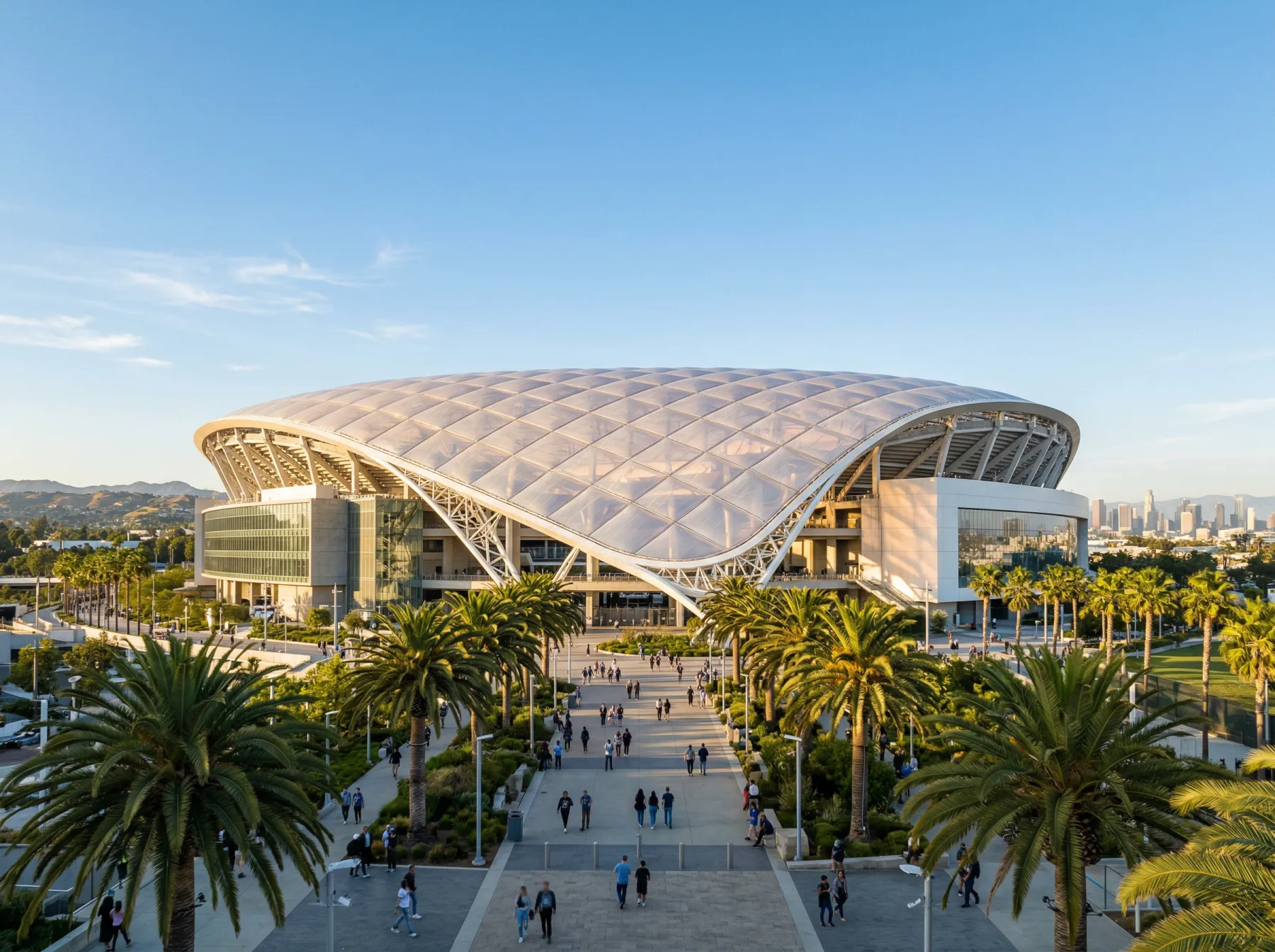
The most expensive stadium ever built — over US$5 billion — sits in Inglewood, California, ten kilometres from LAX airport, and on 16 June it becomes the stage for New Zealand’s return to World Cup football. SoFi Stadium is not just a venue for the 2026 FIFA World Cup; for the All Whites and every Kiwi punter with a stake on Group G, it is where the tournament begins. I have visited SoFi twice for NFL events, and the scale of the place redefines what you think a stadium can be. Understanding its quirks — the roof, the surface, the climate control — is not trivia. It is an edge. Conditions affect outcomes, and outcomes affect payouts.
About SoFi Stadium
Opened in September 2020, SoFi Stadium was purpose-built as the home of two NFL franchises — the Los Angeles Rams and the Los Angeles Chargers. It seats approximately 70,240 for football (the American variety), though FIFA’s configuration for World Cup matches will adjust capacity to accommodate the wider pitch dimensions required for association football. The final matchday capacity is expected to sit around 68,000-70,000 once the pitch layout, broadcast infrastructure and safety zones are accounted for.
The defining architectural feature is the translucent ETFE roof — a canopy that covers the stadium without fully enclosing it. SoFi is technically an open-air venue, but the roof blocks direct sunlight and provides shade across the entire pitch and the majority of seating. The sides of the stadium are open to the elements, which means airflow is natural rather than climate-controlled. For players, this creates a unique environment: protection from the fierce Southern California sun overhead, but exposure to ambient temperature and humidity at ground level. On a June evening in Los Angeles — when the All Whites take the pitch against Iran — temperatures typically range between 18 and 24 degrees Celsius, with low humidity. Those are comfortable playing conditions that favour technical football over brute endurance.
The playing surface for the World Cup will be natural grass, installed temporarily over SoFi’s permanent artificial turf system. FIFA mandates natural grass for all World Cup fixtures, and SoFi’s engineering team has experience with this process — they installed grass for the 2023 CONCACAF Gold Cup matches at the venue. The temporary pitch sits on a modular tray system that maintains root health and drainage while allowing removal after the tournament. For punters, the key question is how the surface holds up across multiple matches. SoFi is scheduled to host group-stage fixtures and potentially knockout rounds, meaning the grass could see six or more matches within three weeks. Pitch degradation in the later stages is a real variable, particularly in the penalty areas and along the touchlines where heavy traffic wears the surface.
The stadium’s location in Inglewood places it within the greater Los Angeles metropolitan area, a region with the largest concentration of football fans in the United States. Los Angeles has a significant diaspora from virtually every qualifying nation, which means SoFi’s atmosphere for World Cup matches will be intense and partisan — particularly for fixtures involving Central American, South American, and Asian teams whose communities are deeply rooted in Southern California. For the Iran v New Zealand match, the stadium’s proximity to a large Iranian-American population (estimated at over 500,000 in the Los Angeles area) adds a layer of atmosphere that could tilt the crowd energy in Iran’s favour, assuming Iran participate.
2026 World Cup Matches at SoFi
FIFA has designated SoFi Stadium as one of the premier match venues for the 2026 World Cup, hosting a significant share of group-stage fixtures and potentially matches deep into the knockout rounds. The exact match allocation depends on FIFA’s final scheduling matrix, but SoFi’s capacity, infrastructure and Los Angeles market make it a certainty for high-profile fixtures. Group G’s opening match — Iran v New Zealand on 15 June (21:00 ET / 16 June, 13:00 NZST) — is confirmed for SoFi, along with additional group-stage matches from other groups.
The venue’s broadcast infrastructure is among the most advanced in the world. SoFi’s Infinity Screen — a massive dual-sided 4K video board suspended from the roof structure — was designed for NFL broadcasts but will serve World Cup viewers with replays, statistics and crowd engagement content. For remote punters watching via satellite or streaming, SoFi’s camera positions and lighting setup produce a broadcast quality that eliminates the visual compromises sometimes seen at older or more compact venues. You will see every touch, every offside call, and every VAR review in granular detail, which matters if you are betting on live markets and need visual confirmation of match events as they unfold.
SoFi is also being considered as a host for one of the quarter-final matches, though FIFA has not finalised the knockout-round allocations. If the All Whites defy the odds and reach the Round of 32, their knockout match would be played at a different venue — but for Group G purposes, SoFi is a one-match affair for New Zealand. The emotional significance of that single match — the World Cup opener, after 16 years away — makes it one of the most consequential fixtures in New Zealand football history.
All Whites at SoFi: The Opener
Sixteen years between World Cup matches. That is the gap New Zealand carries into SoFi Stadium on 16 June. The last time the All Whites played a World Cup fixture was 24 June 2010, a 0-0 draw against Paraguay at Peter Mokaba Stadium in Polokwane, South Africa. An entire generation of New Zealand football fans has never seen their country at a World Cup, and the opener against Iran (or a replacement) is the moment that drought breaks.
For punters, the emotional dimension of this match is a variable that defies easy modelling. New Zealand’s players will carry a weight of national expectation that is disproportionate to their world ranking — the All Whites are not accustomed to this spotlight, and the first twenty minutes will reveal whether the occasion lifts or paralyses them. Historical precedent from comparable situations (small nations returning to a World Cup after long absences) suggests a pattern: a cautious, nervy start followed by gradual settling if the team avoids conceding early. The first goal in this match is critical. If New Zealand score first, the odds of them holding on for a result increase dramatically — underdogs who take the lead in World Cup group openers have held on to win or draw roughly 72% of the time across the last five tournaments.
Chris Wood’s experience at the highest level of English football gives New Zealand a focal point that most underdog squads lack. Wood knows how to play in high-pressure environments — Elland Road, the City Ground, St James’ Park — and SoFi’s atmosphere, intense as it will be, is not alien to a player who has spent his career in the Premier League. Delivering the ball to Wood in dangerous areas from crosses and set pieces is New Zealand’s clearest route to a goal, and SoFi’s dimensions (wider than a typical English ground) actually favour the kind of wide-area service that Wood thrives on.
Conditions and the Punter’s Angle
Here is the detail most previews skip: SoFi’s partially enclosed design creates a micro-climate that is distinct from the outdoor conditions in Inglewood. The roof traps a layer of warm air above the pitch, which on evening kick-offs (21:00 ET in June) means the playing temperature at ground level can be 2-3 degrees warmer than the ambient outdoor temperature. For a match kicking off at 9 PM local time, that is unlikely to be a factor — evening temperatures in June around Los Angeles are mild. But for afternoon kick-offs at SoFi in later rounds, the heat retention under the roof becomes relevant for over/under goals markets and for player energy levels in the final quarter of matches.
The acoustic design is the more significant factor. SoFi was engineered for NFL game-day noise, and the canopy roof amplifies crowd sound in a way that creates genuine atmosphere even when the stadium is not full. For a World Cup match between Iran and New Zealand — where the Iranian-American diaspora will likely outnumber the Kiwi contingent significantly — the noise will favour Iran. Crowd influence on referees is a documented variable in home-advantage research, and while SoFi is a neutral venue on paper, the demographic reality of Los Angeles means Iran enjoy a proximity advantage in fan turnout. This does not change my view on the match odds, but it is worth factoring into yellow card and foul count markets, where referee behaviour correlates with crowd pressure.
Pitch quality on matchday is another angle. SoFi’s temporary natural grass surface will have been installed weeks before the tournament, and the opening fixtures will be played on the freshest pitch of the competition. New Zealand’s match on 16 June is among the earliest in the schedule, meaning the surface will be in optimal condition — firm, even and fast. A fast surface suits technical passing teams, but it also suits New Zealand’s direct, vertical style, where quick balls into the channels and early crosses benefit from predictable bounce and roll. By the knockout rounds, SoFi’s pitch will have deteriorated — but for the All Whites’ opener, conditions should be as close to ideal as a temporary grass installation allows.
Los Angeles: The Host City
Los Angeles in June is a particular kind of experience that first-time visitors rarely anticipate. The weather is mild — the so-called “June Gloom” phenomenon brings overcast mornings and fog along the coast before clearing to sunshine by midday. Temperatures hover around 22-25 degrees Celsius, with almost no rain. For players arriving from European leagues, the adjustment is minimal. For players arriving from the Southern Hemisphere — including New Zealand, where June is winter — the shift to warm, dry conditions requires some acclimatisation, though nothing compared to the extreme heat that World Cup venues in Qatar imposed in 2022.
The city’s infrastructure is sprawling rather than centralised, which affects team logistics. SoFi Stadium sits in the southwestern corner of the LA metropolitan area, and training facilities, team hotels and transportation routes are spread across a region that relies entirely on road travel. Traffic congestion in Los Angeles is legendary — the average commute in the Inglewood area takes twice as long during peak hours as it does off-peak — and FIFA’s match-day transportation corridors will be a critical logistical factor. Teams with nearby training bases gain a small but real advantage in rest and recovery time between sessions and the match itself.
For Kiwi fans making the trip — and the All Whites Supporters’ Club has been organising travel packages since the draw — Los Angeles offers a World Cup experience unlike any previous host city. The cultural diversity of the city means every group-stage match at SoFi will have a genuine fan presence from both competing nations, creating atmospheres that rival anything in South America or Europe. The Kiwi contingent will be small relative to the Iranian-American community, but the novelty of New Zealand at a World Cup in Southern California is the kind of story that attracts neutral supporters, and the All Whites will not lack for sympathetic noise inside SoFi on 16 June.
