
 Available in US
Loading...
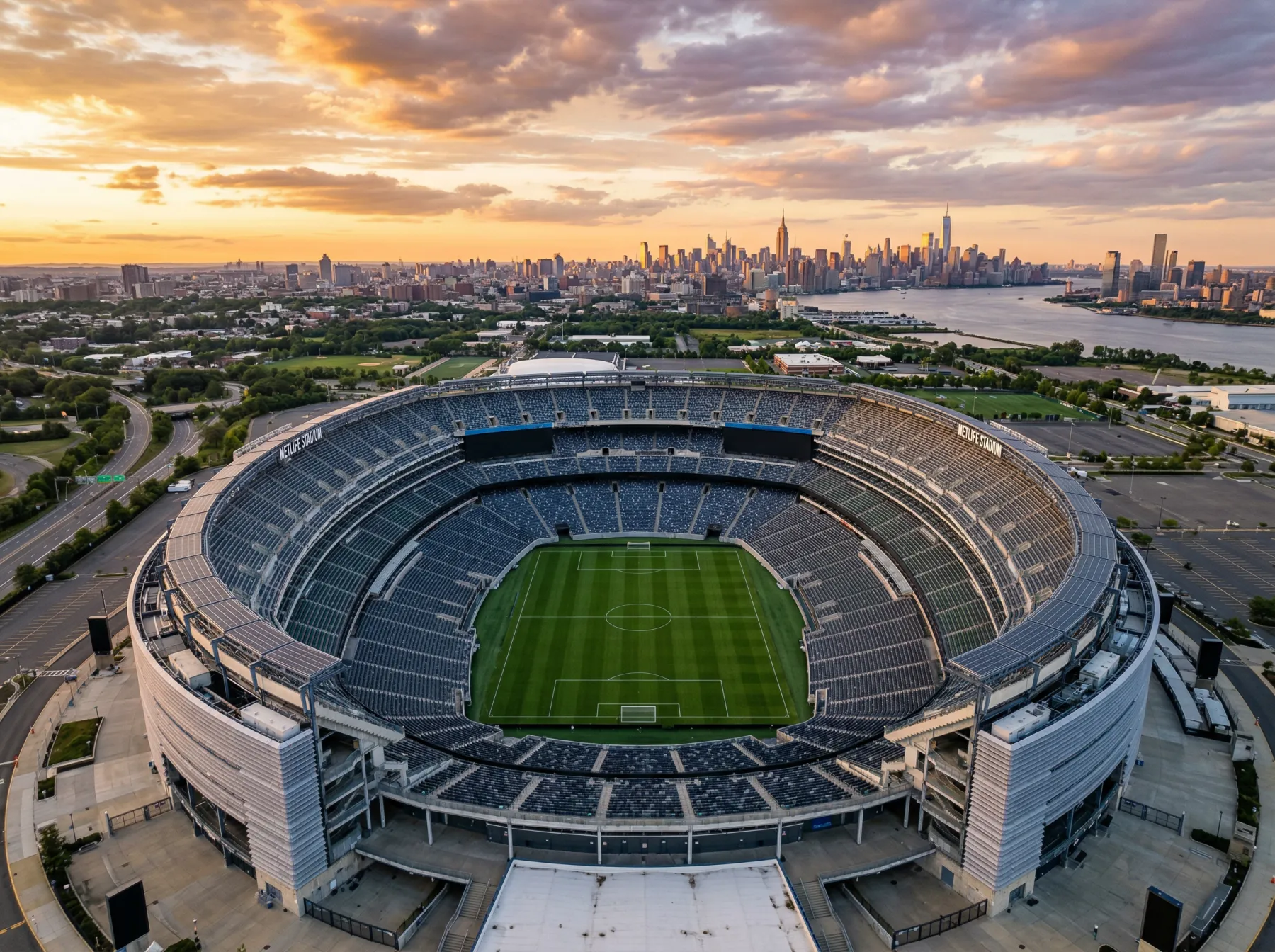
On 19 July 2026, somewhere around 82,000 people will pack into a stadium in the New Jersey Meadowlands and watch two teams contest the biggest match in world sport. MetLife Stadium — built for American football, owned by two NFL franchises, and located in a swampy flatland eight miles west of Manhattan — is not the venue most football romantics would have chosen for a World Cup Final. But FIFA chose it, and the reasons are pragmatic rather than poetic: capacity, infrastructure, and the unmatched media market of New York City. For punters placing outright winner bets or speculating on final-specific markets, understanding this venue is not optional. The stadium itself will shape how the final is played.
About MetLife Stadium
MetLife Stadium opened in 2010, replacing the old Giants Stadium that had occupied the same site since 1976. It is the shared home of the New York Giants and New York Jets, both NFL franchises, and its design reflects American football’s priorities: maximum seating capacity, extensive corporate hospitality infrastructure and sightlines optimised for a narrower, shorter pitch. The standard seating capacity is 82,500, making it the largest stadium in the 2026 World Cup roster and one of the largest sporting venues in the United States. The construction cost of approximately US$1.6 billion was privately financed — a rarity for a stadium of this scale — and the resulting facility is engineered for premium events rather than multipurpose flexibility.
The stadium is an open-air bowl with no roof — a fact that separates it from SoFi Stadium and BC Place, both of which offer some form of overhead protection. MetLife sits exposed to whatever weather conditions New Jersey delivers in mid-July, and those conditions are not gentle. The Meadowlands area is flat, low-lying and historically marshy, which means humidity levels can be oppressive during summer. Average July temperatures in the East Rutherford area range between 25 and 32 degrees Celsius, with humidity often exceeding 70%. For a World Cup Final kicking off at 16:00 or 17:00 local time (the expected window for maximum global broadcast reach), the heat and humidity will be significant performance factors.
The playing surface for the final will be temporary natural grass, as mandated by FIFA. MetLife’s permanent surface is FieldTurf artificial turf, and the conversion to natural grass follows the same modular tray system used at other venues. The critical difference at MetLife is the outdoor exposure — the grass must survive three to four weeks of New Jersey summer sun, heat and occasional thunderstorms without the protection of a canopy or retractable roof. FIFA’s pitch management team will monitor the surface closely, and the grass will be in playable condition for the final, but it will not be pristine. By 19 July, after hosting multiple group-stage and knockout matches, the surface will show wear patterns that affect footing and ball behaviour, particularly in the penalty areas.
The 2026 World Cup Final
A World Cup Final is not just a football match — it is a controlled environment of extreme pressure, and the venue’s physical characteristics interact with that pressure in ways that punters should understand. MetLife’s open-air design means the final will be played in full daylight during the first half (if the kick-off is late afternoon local time), transitioning to artificial lighting as evening falls. That shift in light conditions is a minor but real variable: goalkeepers adjusting to changing angles of sunlight, outfield players reading the ball against shifting backgrounds, and the psychological transition from daytime intensity to evening atmosphere.
The heat factor deserves particular attention. World Cup finals are rarely played in extreme heat — Qatar 2022’s final kicked off at 18:00 local time in December, with temperatures around 24 degrees. The 2018 final in Moscow was a mild 24 degrees. The 2014 final at the Maracana was 23 degrees. MetLife in mid-July could deliver 30+ degrees with 70% humidity at kick-off, making this potentially the most physically demanding World Cup Final in modern history. That has direct implications for the extra-time and penalty markets. If the match goes beyond 90 minutes, both teams will be operating under severe physical stress, and the quality of football in extra time tends to deteriorate more sharply in hot, humid conditions. The probability of penalties increases when neither team can sustain the pressing intensity needed to create clear chances in extra time, and MetLife’s July conditions make that scenario more likely than at a climate-controlled venue.
For outright winner bets, the venue subtly favours teams with superior squad depth and rotation capacity — teams that can bring fresh legs off the bench in the 60th minute without a meaningful drop in quality. Argentina, France, Brazil, England, Germany and Spain all possess that depth. Teams that rely on a core eleven and limited rotation — dark horses who reach the final by squeezing every ounce from their best players — will be at a disadvantage in MetLife’s conditions. If you are placing an outright winner bet before the tournament begins, the venue for the final is one reason to favour deep squads over romantic picks.
Open-Air, July Heat and the Pitch
I have attended summer events at MetLife, and the experience of sitting in an open bowl on a 30-degree afternoon is instructive. The lack of shade for the majority of the seating bowl means the crowd itself is affected by heat — hydration, energy and noise levels all dip in the second half as the accumulated effect of hours in the sun takes hold. For the players, FIFA’s cooling breaks (mandated when the wet bulb globe temperature exceeds a threshold, typically around 32 degrees) will likely be activated, adding stoppages that disrupt tactical rhythm and favour the team that is defending a lead.
The pitch conditions at MetLife by 19 July will reflect weeks of intensive use under summer sun. Natural grass requires consistent irrigation, mowing and recovery time between matches, and MetLife’s schedule — hosting group-stage matches, Round of 32 fixtures and potentially quarter-finals before the final — means the surface will have endured six to eight matches in the five weeks before the showpiece. Expect uneven footing near the goal areas, divots in the centre circle where the restart ball impacts repeatedly, and potentially bare patches along the touchlines where the grass has been unable to recover between fixtures. These surface imperfections affect passing accuracy, dribbling confidence and the reliability of the bounce — all variables that increase the probability of defensive errors and unexpected goals.
The wind at MetLife is another factor that gets overlooked. The Meadowlands sit in a low-lying corridor between the Hudson River and the Hackensack River, and prevailing winds from the southwest can swirl inside the open bowl, creating inconsistent air currents that affect long passing, crosses and free-kick delivery. In the 2014 Super Bowl at MetLife — the first open-air Super Bowl in a cold-weather city — weather conditions were a talking point. For a World Cup Final in July, the wind is less likely to be extreme, but the swirling air patterns inside the bowl remain a constant. Free-kick and corner-kick specialists who rely on precise ball flight may find MetLife’s air currents frustrating, and that variability feeds into set-piece markets.
Other World Cup Matches at MetLife
MetLife Stadium will host a significant number of matches beyond the final, including group-stage fixtures and knockout rounds. The venue’s capacity and proximity to the New York media market make it a natural choice for high-profile fixtures — expect at least one semi-final and potentially both to be staged in the Meadowlands. The exact match allocation depends on FIFA’s final scheduling, but MetLife’s role as the final venue means it will be treated as the tournament’s flagship stadium, with pitch management and infrastructure standards maintained at the highest level throughout.
For group-stage matches at MetLife, the key variable is the same as the final: July heat and open-air exposure. Teams drawn into groups with MetLife fixtures in the second and third matchdays will face a surface that has already been used, in conditions that demand physical resilience. Over/under goals markets for MetLife fixtures may warrant adjustment — historically, matches played in heat and humidity above 28 degrees produce slightly fewer goals than average, as both teams conserve energy and pressing intensity drops. The exceptions are matches between a strong favourite and a significant underdog, where the quality gap overrides the physical conditions and scorelines tend to be higher.
The semi-final fixtures at MetLife — if both are staged there — represent the best value opportunity in the late-tournament markets. By that stage of the competition, the pitch will have had time for maintenance between matches, and the evening kick-offs will benefit from cooler temperatures as July nights bring the ambient temperature down to a more manageable 24-26 degrees. Semi-finals tend to be tight, tactically cautious affairs, and MetLife’s conditions in the evening window support that pattern. Draw at full time in semi-final markets at MetLife is a bet I will be watching closely as the tournament bracket takes shape.
East Rutherford and the New York Connection
MetLife Stadium is technically located in East Rutherford, New Jersey, not New York City — a distinction that New Jerseyans insist upon and that New Yorkers cheerfully ignore. The stadium sits within the Meadowlands Sports Complex, which also includes the Izod Center and the Meadowlands Racetrack, and is accessible from Manhattan via the NJ Transit rail line to Meadowlands Station (a dedicated spur that operates on event days) or via the New Jersey Turnpike by car. The transit connection is approximately 25 minutes from Penn Station in midtown Manhattan, making MetLife one of the more accessible large-venue stadiums in the United States despite its suburban location.
The New York metropolitan area — 20 million people within a 50-mile radius — gives MetLife an audience base that dwarfs any other World Cup venue. The city’s extraordinary cultural diversity means every competing nation has a significant fan community within driving distance of the stadium. For the final, this translates into an atmosphere that will be genuinely electric, with both finalist nations represented by passionate diaspora communities supplemented by neutral fans drawn from the global capital of international sport. The noise inside MetLife for the final will rival any World Cup venue in history, and that atmosphere creates the high-pressure environment where experienced tournament performers thrive and less battle-tested sides can falter.
For Kiwi fans, MetLife is relevant only if the All Whites produce the most improbable run in World Cup history — and while I am an optimist, I am also a realist. But for punters placing outright winner bets and final-specific markets, understanding MetLife’s conditions, its pitch, its heat, and its atmosphere is the kind of preparation that separates informed betting from guesswork. The stadium will shape the final, and the final will define the tournament. Knowing the venue is knowing the battlefield.
